Git Worktrees Aren't a Magic Bullet for Your Agents
Git worktrees are having a moment. The pitch is that they’re the way to run coding agents in parallel: one worktree per agent, each on its own branch, no collisions. Anthropic recommends it in the Claude Code docs, and there’s a small genre of posts now about wiring worktrees up and turning four agents loose at once.
They are not the magic bullet they get sold as. The pitch skips the internals, and on a heavy app the internals are the whole story. If you don’t understand how a worktree actually works, you can follow the advice straight into a worse spot than where you started.
What a worktree actually shares
The git object database and your refs, through a pointer back to the main .git. That’s it. The working directory is
brand new, the index is brand new, and every file git doesn’t track, node_modules, build output, .env, every cache,
is either absent or freshly duplicated. The part it shares, your commit history, is the part that was never expensive.
The part it doesn’t share is everything that makes a large app slow.
Where the weight is
So an agent in a fresh worktree can’t lean on anything to validate its work. It installs its own dependencies, boots its own dev server, its own test server. For a real app that’s the whole cost of a working environment, paid again per worktree.
And the apps I work in are big. The front end is north of a million lines and around 9.5GB on disk, close to 5GB of it
node_modules; the services behind it run into the hundreds of thousands of lines, a few gigabytes each. None brings a
dev or test server up quickly, and once it’s up the working set is near 10GB. The git history is the small part, well
under a gigabyte each. That’s all a worktree saves you; everything else it hands back to rebuild, every time.
Then there’s the part nobody mentions: ports. The dev and test servers want fixed ports, wired into config that assumes one checkout. A second environment fights for the same ones, so you’re remapping them just to coexist. These apps were built before anyone pointed an agent at them; a worktree doesn’t ease that, it just gives you a second place to fight it.
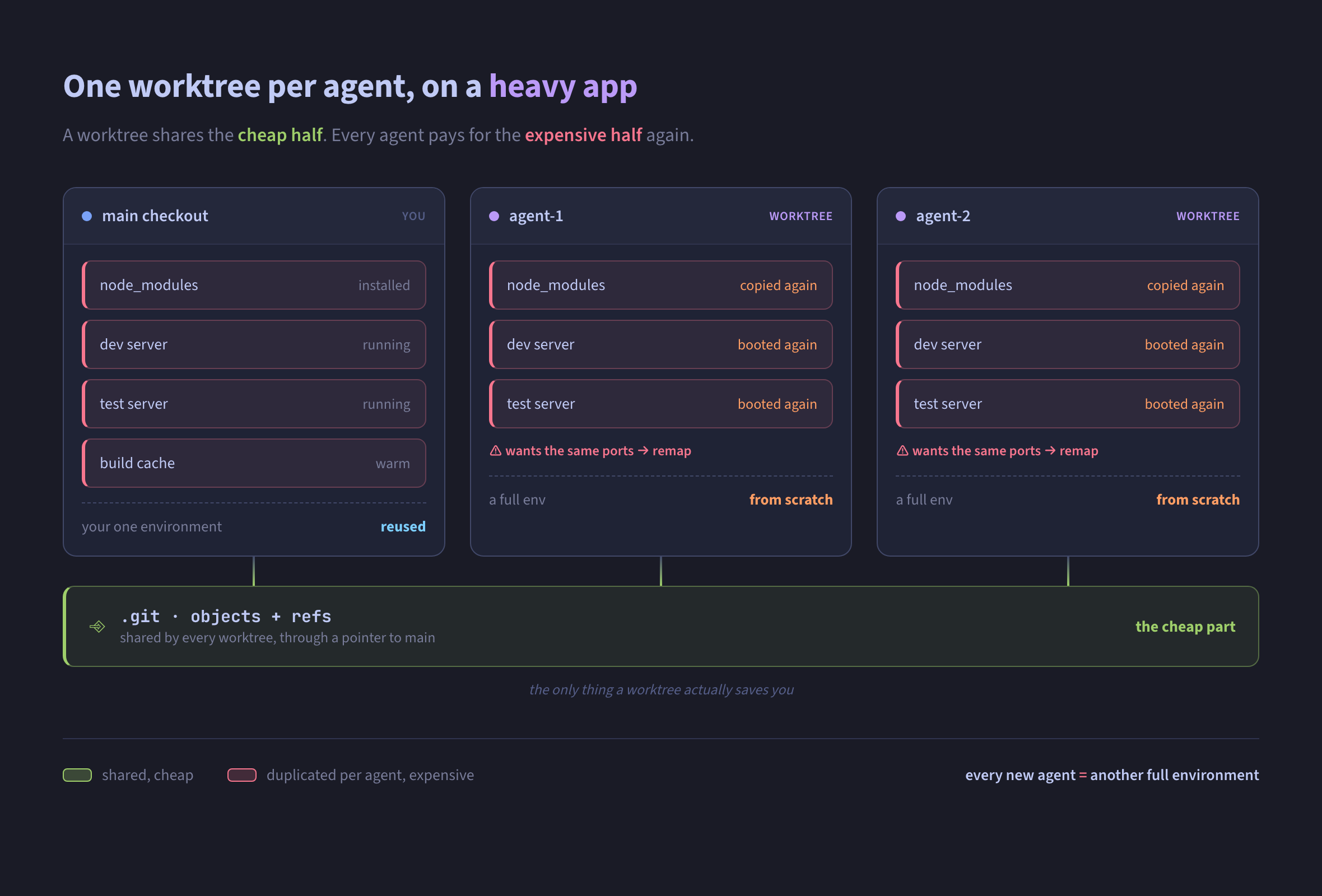
Every worktree copies the expensive half: dependencies, both servers, the same contested ports. The only thing shared is the git history, the part that was never the problem.
Where worktrees still earn it
I don’t think worktrees are a mistake. They’re genuinely good in cases mine just aren’t.
If your dependencies are light, none of this bites. A small or mid-size repo where install is seconds and there’s no
long-running server is the case every worktree tutorial is quietly written for. Compiled languages are another fit:
keeping an expensive build warm on one branch while you check out another is exactly what a separate working directory
is for. And a quick hotfix on a second branch without disturbing what you’ve got staged is cleaner through a worktree
than through git stash. The common thread is a cheap or reusable environment. The moment the environment is the
expensive part, the worktree stops paying for itself.
What I do instead
I keep one dev server and one test server running against a single warm checkout. The agent does its work and pushes to remote; I pull the changes in and verify there. One environment, warm the whole time, instead of one provisioned and torn down per branch.
I first tried this with the agent in a worktree of the same repo, then checking its branch out in the warm repo to
verify. Git won’t allow it: the same branch can’t be checked out in two worktrees at once (fatal: 'branch' is already checked out at ...). That lands right on the move I want, since the whole point of the warm repo is to pull in the
agent’s finished branch and look at it. A separate clone sidesteps it: the agent pushes, I pull into the warm clone, done.
The remote roundtrip I’d have called overhead is the clean path, the work arriving through git like anyone else’s would.
None of this makes worktrees bad. It makes them a tool with a shape, and that shape happens to fight mine. Learn what a worktree shares and what it refuses to do, hold it against how you really work, and keep what fits.